
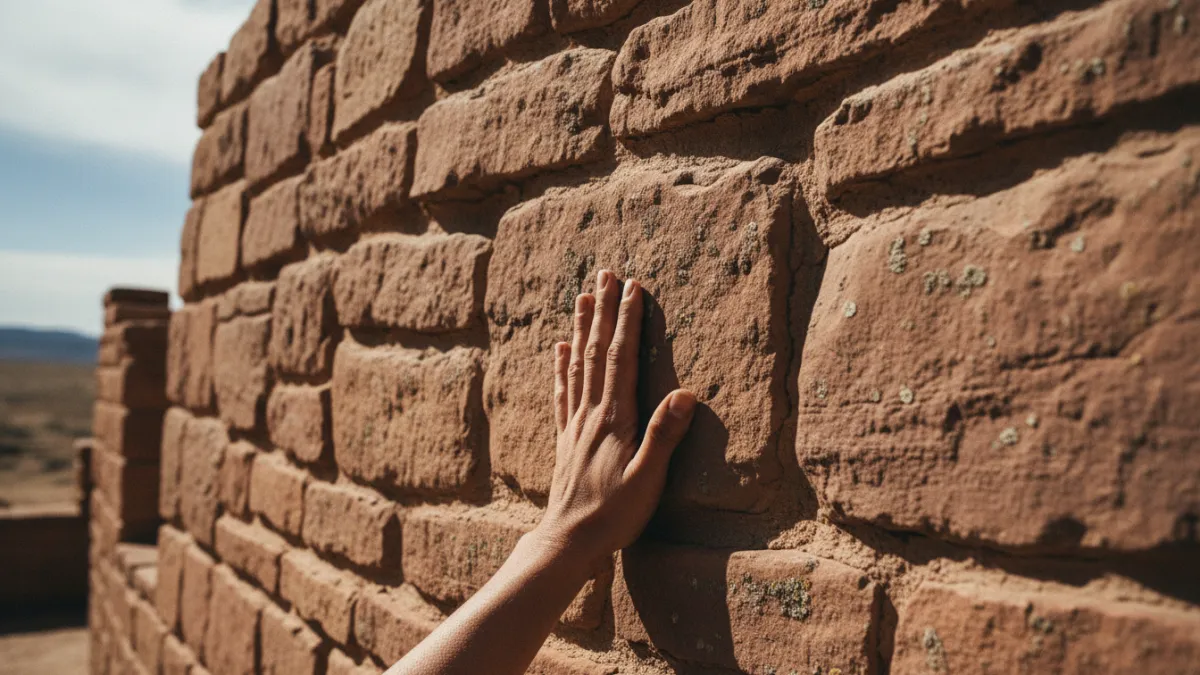
Most visitors treat Chaco Canyon as a ruin site. That misreads the evidence entirely. These great houses functioned as precision astronomical instruments, aligned to solar and lunar cycles within margins modern engineers still struggle to explain.
Chaco comme témoin des ancêtres Pueblo
53.06 square miles. That is the total protected footprint of Chaco Culture National Historical Park — a density so extreme it concentrates over 3,600 archaeological sites within a single bounded landscape.
This concentration is not accidental. The Ancestral Puebloans engineered Chaco Canyon as a deliberate center of gravity for an entire civilization. At its peak, between 850 and 1150 CE, the canyon functioned as a regional hub — political, ceremonial, and astronomical — drawing communities from hundreds of miles across the Colorado Plateau.
The UNESCO World Heritage designation, granted in 1987, reflects three compounding realities that any serious visitor should understand before arriving:
- The Great Houses represent the largest pre-Columbian structures in North America — not simply in scale, but in organizational complexity, requiring coordinated labor across generations.
- The 3,600+ recorded sites mean that nearly every surface feature carries archaeological significance; off-trail movement is not a minor infraction, it is direct damage to irreplaceable data.
- The road network radiating from Chaco — some segments still visible from above — indicates a logistical system far beyond local subsistence needs.
- The canyon's astronomical alignments, embedded in architecture, demonstrate that spatial planning operated on celestial timescales.
Understanding these mechanisms transforms a site visit from passive observation into active reading of one of North America's most sophisticated pre-contact civilizations.
Les grands sites majestueux de Chaco
Two structures define Chaco's architectural ambition at scale: Pueblo Bonito, where spatial organization encoded political power, and Chetro Ketl, where masonry technique became a replicable engineering system.
Le joyau de Pueblo Bonito
Between 650 and 800 rooms packed into a D-shaped footprint of just 2 acres — that density alone signals that Pueblo Bonito was never a simple residential complex. This structure, the largest in Chaco Canyon, operated as a centralized node where ceremonial activity, long-distance trade, and political coordination converged under one architectural logic.
| Feature | Detail |
|---|---|
| Rooms | 650–800 |
| Area | 2 acres |
| Stories | Up to 4 levels |
| Great Kivas | At least 2 |
The room count variability — 650 on the conservative end, 800 at peak estimates — reflects ongoing archaeological debate about which spaces served as storage versus active occupation. That distinction matters: Ancestral Puebloan architecture encoded social hierarchy directly into spatial organization. Ceremonial kivas anchored the ground plan, while upper-story rooms tracked the sun's movement with deliberate precision. Pueblo Bonito wasn't built to shelter a population. It was engineered to concentrate power.
La maçonnerie de Chetro Ketl
Over 50 million stones. That single figure reframes how you read Chetro Ketl's walls.
The core-and-veneer technique is the structural logic behind this scale. Builders assembled a rubble-and-mortar core, then faced it with precisely shaped stone veneers — a two-layer system that distributed load while projecting a finished, geometric surface. The outer layer wasn't decorative. It was load-bearing precision.
What makes this approach significant is its replicability at volume. Each veneer stone required individual shaping and placement, meaning the 50 million figure represents millions of discrete engineering decisions, not bulk material stacking. The consistency visible across Chetro Ketl's surviving walls confirms a standardized construction logic, not improvised labor.
You can read the masonry itself as a technical document. Variations in stone size and coursing patterns across different construction phases reveal how builders adapted their technique over time, responding to structural demands without abandoning the core system.
Together, these two great houses establish a consistent architectural logic — one that extended far beyond Chaco Canyon through a network of roads and outlier sites.
Découverte des trésors cachés de Chaco
Chaco Canyon holds three distinct layers of knowledge: a ceremonial architecture calibrated to the sky, a carved archive on sandstone, and a trail network that makes both readable.
Les mystères de Casa Rinconada
At 63 feet in diameter, Casa Rinconada stands among the largest great kivas ever constructed by the Ancestral Puebloans. Subterranean by design, this circular chamber functioned as a community ceremonial hub, drawing participants from across the Chaco Canyon landscape.
The architecture is not arbitrary. A north-facing doorway aligns precisely with the summer solstice sunrise, while specific wall niches capture solar light at astronomically significant moments throughout the year. This level of archaeoastronomical precision required systematic observation across generations — not a single builder's intuition.
The structure also features four massive floor vaults and a raised firebox positioned along a strict north-south axis. Each element reinforces a spatial logic oriented toward celestial cycles. Researchers interpret this alignment as evidence that ritual timing was governed by direct observation of solar and lunar patterns.
Casa Rinconada functions, in this sense, as a calibrated instrument — one that synchronized human ceremony with the measurable rhythms of the sky.
Les récits gravés des pétroglyphes
Scattered across the park's sandstone surfaces, petroglyphs carved by Puebloan people function as a layered archive — part cosmology, part historical record, part territorial marker. Each incised figure was deliberate. Spirals track solar cycles, anthropomorphic forms document ceremonial roles, and animal imagery maps the relationship between human communities and their environment.
The mechanism here is precise: rock carving wasn't decorative impulse. It was a structured communication system, encoding knowledge that oral tradition alone couldn't preserve across generations. You can read these surfaces as the Puebloans' most durable medium — stone outlasting memory, drought, and migration.
What travelers often miss is the density of meaning compressed into a single panel. One composition can simultaneously reference a specific astronomical event, a clan's lineage, and a seasonal ritual. That layering is what separates Puebloan petroglyphs from simple pictorial art. They are records built to be read by those who held the interpretive key — and studied today by archaeologists working to reconstruct that knowledge.
Les sentiers recommandés pour explorer Chaco
The ancient road network at Chaco stretches over 400 miles — a scale that reframes how you approach trail selection. Two routes stand out for what they reveal, not just what they cover.
The Pueblo Alto Trail (3.6 miles round trip) climbs to the mesa top, where you gain a direct sightline over the canyon's great houses. From this elevation, the geometric precision of the road system becomes visible on the ground, connecting sites that appear isolated from below.
The South Mesa Trail (3.7 miles round trip) runs the opposite ridge, positioning you above Tsin Kletzin and offering a broader spatial reading of the entire complex.
Both trails share the same operational constraint: Chaco sits far from services, with temperatures swinging dramatically between dawn and midday. You carry your water, full stop. Starting before 8 a.m. in summer is not a preference — it's a margin of safety. Sturdy footwear handles the uneven sandstone without negotiation.
These three systems — spatial, symbolic, and physical — are not separate attractions. They form a single interpretive framework that rewards preparation over improvisation.
Chaco's architecture encodes astronomical alignments no modern survey can fully replicate. Before your visit, download the park's official site map and check road conditions on NPS.gov — the 21-mile dirt access road closes without notice after rain.
Questions fréquentes
Which road should I take to reach Chaco Culture National Historical Park?
Always use the North access route: US 550 to CR 7900. The South access road is unpaved, prone to flash flooding, and impassable for standard vehicles. Budget 13 miles of rough dirt road even via the North approach.
Are food, water, or supplies available inside Chaco Canyon?
No commercial services exist within the park. You must carry all food, water, fuel, and firewood. Cell service is nonexistent. The nearest town is over an hour away. Total self-sufficiency is the baseline requirement, not an option.
Why was Chaco Canyon abandoned by the Ancestral Puebloans?
Abandonment accelerated around 1130 AD. A 50-year drought cut annual precipitation to 6.5 inches, while systematic deforestation had already depleted local timber and topsoil. The regional system collapsed under compounded environmental and logistical strain.